
Blog
Electroplating the DotShell

Dec
Working on finish and colors of vaping devices, especially atomisers, can be very tricky – mainly because of two crucial factors: conductivity and contact with e-liquid. Consequently, aesthetics is not the only parameter that defines the choice of finishing method, because the choice is essentially filtered by the two restrictive factors as above.
Conductivity and impact of e-liquids
In regards to conductivity, most of the finishing choices create a non-conductive layer. This creates the need to mask the threads and other critical points of certain parts that take part in the device’s electric circuit, in order to ensure they will remain electrically functional, with the exception of certain electroplating options that leave the parts conductive after plating. Despite being coloured, electroplated parts remain properly conductive when it comes to non-coloured chrome, silver, and gold plating.
Even more important is the behaviour of colour finishes when in contact with e-liquid. E-liquids can be aggressive, reducing the life span of color on surfaces. This, in turn, creates a more crucial issue: diluted substances pose a health risk, after they escape the coloured surface with the aid of aggressive e-liquids. Colored tanks and decks, inside out, are really sexy. But are they durable? And most important, are they safe?
Electroplating the DotShell
Out of all possible choices for colouring inner surfaces of atomisers in contact with e-liquid, the most durable and least prone to cause health issues have proven to be vacuum deposition methods (PVD, DLC) and electroplating, while electroplating is the only method to be offering some benefits with conductivity. Despite being coloured, electroplated parts remain properly conductive when it comes to non-coloured chrome, silver, and gold plating. Of course you still need masking when it comes to plating with other metal mixtures.
With our electroplating application on the DotShell, we have made sure that we use chrome, titanium and gold with non-toxic additives. It should be noted, that it is in no way recommended to use the plated parts with highly acidic liquids at high temperatures. Under these extreme conditions the plated layer tends to dissolve and wears off much faster over time. Same happens when cleaning with aggressive detergents. Plated surfaces will not last forever. But they will last more than other finishing options, especially if we mind the liquid they host and the use we make. The choice of electroplating will definitely increase the life of colored surfaces and will ease our troubles even when the plated surface eventually starts to gradually wear off.
With electroplating we use electricity to coat a relatively mundane metal with a thin layer of another, more precious and nice looking metal mixture. Electroplating involves passing electric current through a solution called an electrolyte. This is done by dipping two terminals called electrodes into the electrolyte and connecting them into a circuit with a battery or other power supply. The electrodes and electrolyte are made from carefully chosen elements or compounds. When the electricity flows through the circuit they make, the electrolyte splits up and some of the metal atoms it contains are deposited in a thin layer on top of one of the electrodes—it becomes electroplated. In the case of our application on the DotShell, the typical SS316F core of DotShell parts is electroplated with a thin layer of titanium and chrome for Midnight Black and Iron Grey finishes, while titanium, chrome and 18k gold are used for the Gold finish.
The typical thickness of plated metal varies from about 0.5 microns (0.5 millionths of a meter or 0.0005 millimeters) up to about 20 microns (20 millionths of a meter or 0.02 millimeters)—so that’s extremely thin. To give you some idea, aluminum kitchen foil sits roughly in the middle of that range, with the thickest and strongest foil coming in at about 10–20 microns. This means that plated parts should be treated carefully, as their external layer is sensitive against bumps and scratches.
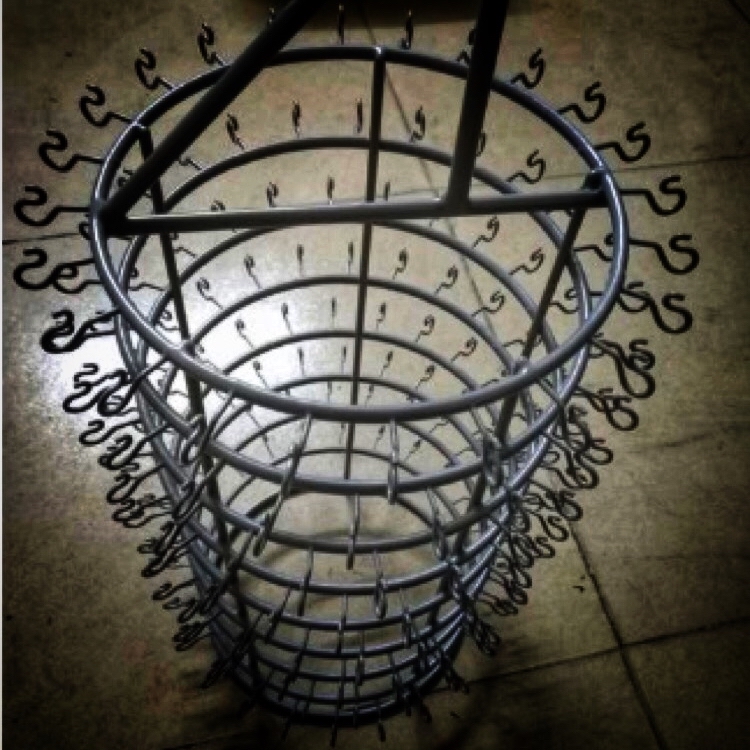
A common method of electroplating parts is the rack plating method. This method involves plating metal parts by hanging them on a metallic fixture which supplies the galvanic cell circuit necessary for the electroplating process. Essentially this requires that the parts to be plated are in touch with the rack wires at certain points. This causes a couple of small marks at specific points of each part, that are inevitable with the plating process.
Besides small marks on points of inner surfaces, one should also expect iridescence effect to appear on certain areas of plated parts plus slight tonic differences in the color between parts and especially between batches. These are also attributed to the very nature of electroplating and its procedures. Iridescence has to do with several settings of the plating procedure, but mostly with the fact that deposition is weaker on small and inner surfaces. In the same way with the small marks, we have tried to reduce the iridescence effect and mainly limit it to inner surfaces of the device (inside the chimney and deck) – also minimise it there as much as possible – and not affect the outer surfaces aesthetics. Typical with electroplating are tonic differences, which are expected in the same color between batches. Differences are not visible with bare eyes in the case of Midnight Black and Gold, and appear to be more intense with the Iron Grey. We have managed to achieve minor tonic differences even in this case and most important, we keep separately stock of parts from different batches, in order to make sure that replacements will come from the same batch with the device when needed.
Summing up
After trying out several things over the past years, we feel that electroplating is the best option even though not perfect. Like all other colouring options, it is not a friend of high temp and acidic liquids, still being more durable. Also, it does not overcome certain aesthetic limitations of most deposition (PVD and DLC) methods. However, its overall finishing quality and properties make it a healthier choice which is expected to last longer compared to other methods that are used in the vaping industry, when it comes to colouring an atomiser.
